
Polished Concrete vs Grind and Seal: Which Service Should You Buy?
When Does Your Facility Need Concrete Floor Grinding Polishing?
Concrete floor grinding polishing is a multi-step mechanical process that transforms a raw or worn concrete slab into a durable, low-maintenance finished surface. Here's a quick breakdown to help you decide what you're looking for:
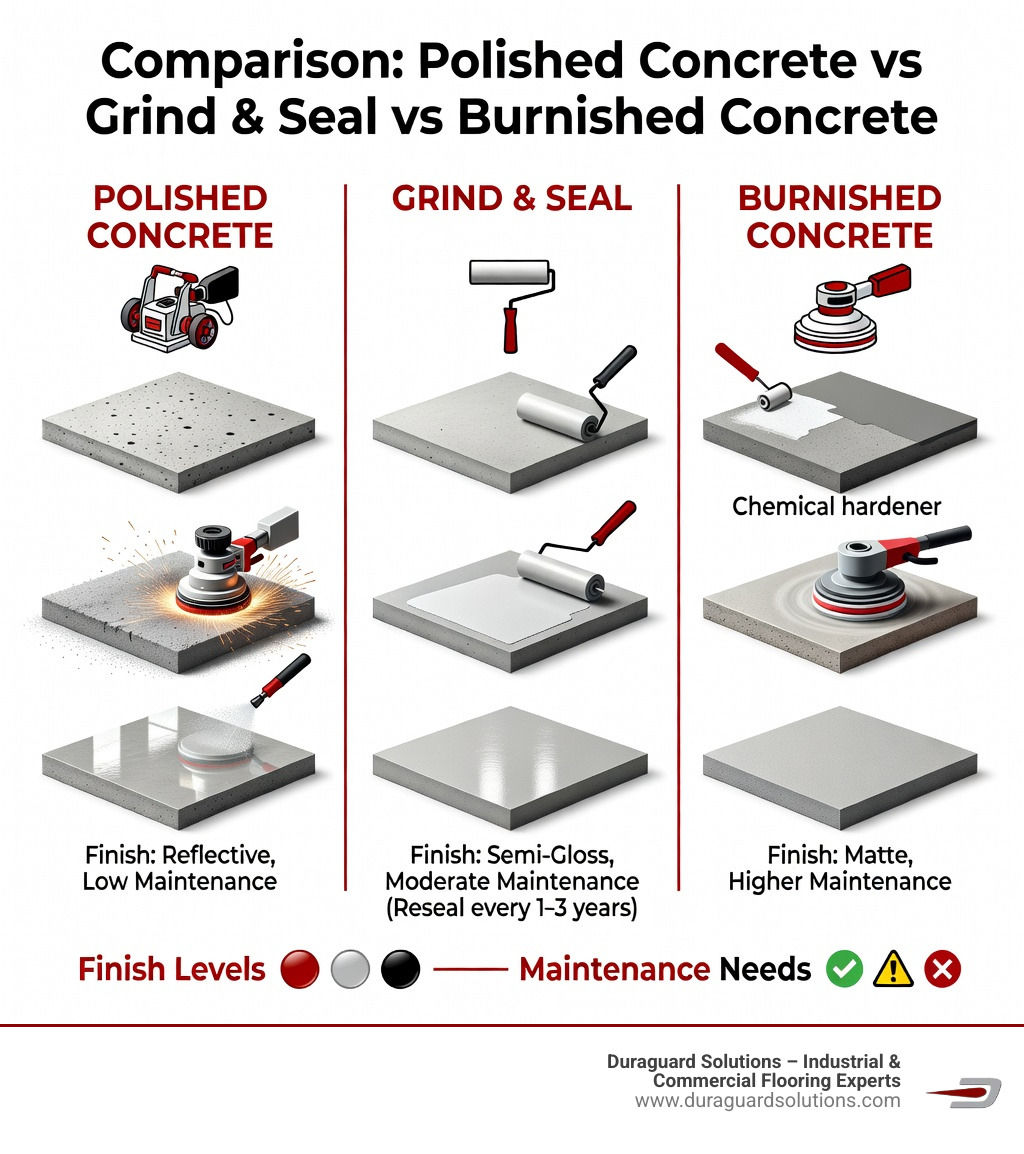
Option Process Best For Maintenance Polished Concrete Grind + densify + polish to 1600–3000 grit High-traffic commercial, industrial Low — no resealing needed Grind and Seal Grind + apply topical sealer Stain-prone areas, tighter budgets Moderate — reseal every 1–3 years Burnished Concrete High-speed buff a chemical coating Budget projects, light traffic Higher — coating wears faster
The right choice depends on your floor condition, traffic levels, and how much ongoing maintenance your facility can handle.
For most facility managers in food processing, manufacturing, or warehousing, the core question isn't whether to refinish the concrete — it's which method actually holds up under forklifts, chemical spills, and daily wear. Getting that wrong means paying twice.
I'm Mark Barr, owner of Duraguard Solutions and an industrial flooring specialist with extensive hands-on experience in concrete floor grinding polishing for warehouses, manufacturing plants, and food processing facilities across Wisconsin and Illinois. In this guide, I'll walk you through exactly what separates polished concrete from grind and seal — so you can make a confident, informed decision before spending a dollar.
Polished Concrete vs. Grind and Seal: Core Differences
At first glance, a polished floor and a grind-and-seal floor might look identical. They both have that sleek, professional sheen that makes a warehouse or showroom pop. However, the "magic" of Polished concrete happens within the slab itself, while a grind-and-seal relies on a protective layer sitting on top.
Mechanical Refinement vs. Topical Protection
True concrete floor grinding polishing is a mechanical refinement process. Think of it like sanding wood. We use progressively finer diamonds to close the pores of the concrete until it naturally reflects light. Because the shine is mechanical, there is no "film" to peel or flake off. This is why Polished concrete is trending in high-traffic Illinois and Wisconsin facilities—it simply doesn't wear out like a coating does.
In contrast, a "Grind and Seal" involves grinding the concrete to a relatively coarse level (usually stopping at 80 or 120 grit) and then applying a topical sealer like acrylic, polyurethane, or epoxy. The sealer provides the gloss and the stain protection. It’s a great, cost-effective solution for areas prone to harsh chemical spills—like commercial bathrooms or small workshops—but that sealer will eventually wear down and require a refresh.
Burnished Concrete: The Budget Alternative
You might also hear the term "burnished concrete." This is the fastest, most affordable way to get a glow on a floor. We use high-speed burnishing machinery that spins at 1,500 to 2,500 rpm to buff a chemical coating into the pores. While it looks great initially, it lacks the deep durability of a multi-step mechanical polish.
Maintenance Cycles
If you choose a grind-and-seal, expect to reseal the floor every 1 to 3 years depending on forklift traffic. With true concrete floor grinding polishing, your maintenance is mostly limited to dust mopping and the occasional damp mop with a pH-neutral cleaner. Over 20 years, the mechanical polish is almost always the most cost-effective choice.
Feature Polished Concrete Grind and Seal Burnished Concrete Primary Shine Source Mechanical Refinement Topical Sealer High-speed Friction Durability Extremely High Moderate (Sealer wears) Low to Moderate Stain Resistance High (with densifier) Excellent (barrier) Moderate Initial Cost Higher Lower Lowest Lifespan 20+ Years 3-5 Years (Sealer life) 1-2 Years
The Technical Process of Concrete Floor Grinding Polishing
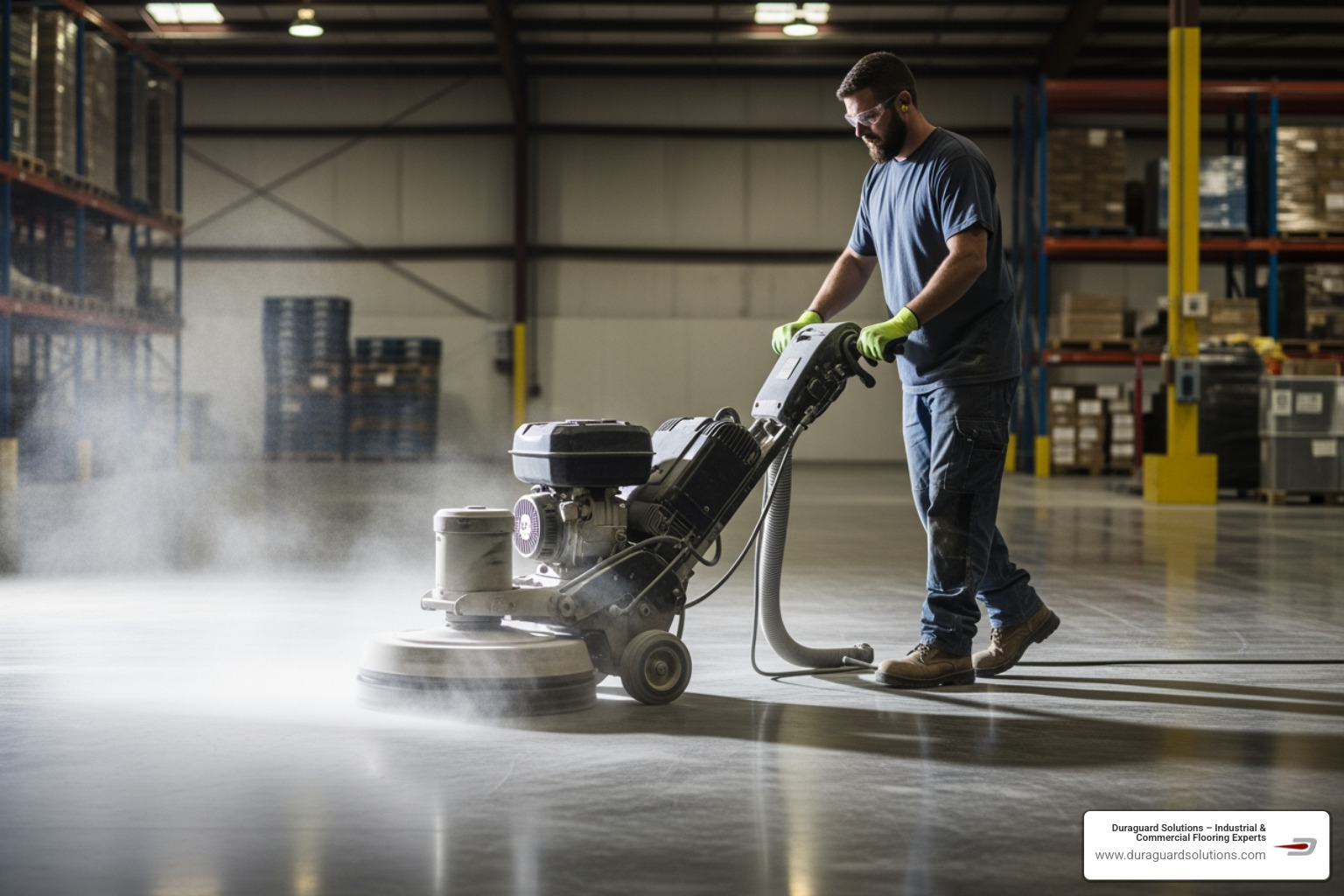
Achieving a mirror-like finish isn't about luck; it's about a disciplined set of steps. We use heavy-duty planetary floor grinders—machines that use multiple spinning heads to create a perfectly flat, uniform surface.

The Honing Stages
After the initial heavy grinding, we move into the "honing" phase. This is where we transition from metal-bonded diamonds to resin-bonded diamonds. Honing removes the visible scratches left by the coarse metal tools and begins to "tighten" the surface. This step is critical for high-performance industrial flooring systems because it increases the density of the floor, making it resistant to the heavy weight of machinery.
Gloss Levels and DOI
We measure our success using "Distinctness of Image" (DOI). This isn't just about how shiny the floor is; it's about how clear the reflection is. We offer four levels of gloss:
Level 1 (Matte): Soft glow, no sharp reflections.
Level 2 (Satin): Clean reflection with some blurriness.
Level 3 (Polished): Sharp, clear reflections from a distance.
Level 4 (High-Gloss): Mirror-like finish where you can read the fine print of overhead signs in the floor's reflection.
Step-by-Step Concrete Floor Grinding Polishing
Preparation: We start by removing old coatings, glues, or mastics.
Grinding: Using 16- to 30-grit metal diamonds, we open the concrete and level out high spots.
Honing: We progress through 80, 150, and 200 grit. This is often where we apply a densifier.
Polishing: We switch to resin pads, moving from 400 up to 1600 or even 3000 grit for that ultimate shine.
Sealing: We apply a "stain guard"—not a thick sealer, but a penetrant that helps protect against oil and water.
This process is particularly vital for warehouse flooring, where a dust-free environment is required for sensitive inventory.
Choosing the Right Grit for Concrete Floor Grinding Polishing
How do we know where to start? We don't guess. We use a MOHS hardness test kit to determine the concrete's hardness. If the concrete is "soft," we use hard-bond diamonds; if the concrete is "hard," we use soft-bond diamonds. Starting with the wrong tool can either burn the diamonds or fail to cut the floor entirely. For new slabs, we look for a minimum of 3500 psi and a Floor Flatness (FF) level of 50 or higher to ensure the best results.
Essential Equipment, Densifiers, and Safety Standards
Professional concrete floor grinding polishing requires more than just a grinder. One of the most important pieces of equipment we bring to your Illinois or Wisconsin facility is our industrial HEPA dust extraction system.
Dust Control and OSHA Compliance
Concrete dust contains silica, which is hazardous if inhaled. We follow strict OSHA silica regulations by using M-Class or H-Class dust extractors that capture 99.9% of particles. This keeps your facility running and your employees safe during the installation.
The Role of Concrete Densifiers
You cannot have a truly polished floor without a densifier (typically lithium or sodium silicate). When we apply this chemical, it reacts with the calcium hydroxide in the concrete to create "C-S-H" (calcium silicate hydrate). This fills the microscopic pores, making the concrete significantly harder and "dust-proof." It’s a core component of chemically resistant flooring because it prevents liquids from soaking in.
Safety and Slip Resistance
A common myth is that polished concrete is slippery. In reality, because the surface is so flat, it often has a higher "coefficient of friction" than dry, unpolished concrete. We can also add slip-resistant additives to our final stain guards to ensure your facility meets all safety standards. Learn more about protecting your floors to maintain these safety features over time.
Cost Analysis and Performance Benefits
While the initial cost of concrete floor grinding polishing (typically ranging from $3 to $15 per square foot depending on the complexity) might be higher than a simple paint job, the long-term ROI is unmatched.
Long-Term ROI and Lifecycle Costs
In an automotive showroom, the floor is a marketing tool. In a food processing facility, it's a hygiene requirement. In both cases, polished concrete wins because it doesn't require the expensive "strip and wax" cycles associated with VCT or the frequent recoating of thin epoxies.
Energy Savings and LEED Approval
Polished concrete is an environmentally friendly choice. It is LEED-approved because it uses the existing slab rather than new materials. Furthermore, the high light reflectivity can reduce your energy bills. In large aircraft hangars, the reflective floor helps illuminate the underside of the aircraft, improving safety and reducing the need for high-intensity overhead lighting.
Frequently Asked Questions
What is the difference between concrete grinding, honing, and polishing?
Grinding: The "heavy lifting" phase using metal-bonded diamonds (16–70 grit) to remove coatings and level the slab.
Honing: The transition phase (100–400 grit) that removes scratches and begins to smooth the surface.
Polishing: The final refinement (800–3000 grit) using resin pads to create the gloss.
How long does the concrete grinding and polishing process take?
For a standard 200 square metre (roughly 2,150 sq. ft.) warehouse, the process usually takes 8 to 12 hours of active work spread across two days. This allows for proper drying time for densifiers and stain guards. Larger industrial projects are scaled with multiple machines to meet tight deadlines.
Can old or damaged concrete be polished?
Absolutely. We specialize in retrofitting old slabs. If the floor is in very poor condition, we may recommend a 50mm (2-inch) topping slab or use epoxy fillers to repair cracks and "spalls" (holes) before we begin the concrete floor grinding polishing process. This ensures the final result is smooth and structurally sound.
Conclusion
Choosing between polished concrete and a grind-and-seal comes down to your specific needs. If you need a floor that can withstand heavy forklift traffic for decades with minimal maintenance, true polished concrete is the gold standard. If you are on a tighter budget or need maximum protection against specific chemical stains in a low-traffic area, a grind-and-seal is a fantastic alternative.
At Duraguard Solutions, we serve the entire Illinois and Wisconsin region with specialized equipment and a commitment to durable, hygienic, and seamless flooring. Whether you're managing a local warehouse or a massive manufacturing plant, we have the expertise to transform your concrete.
Ready to upgrade your facility? Contact Duraguard Solutions for a Quote today and let us help you find the perfect flooring system for your needs.
