
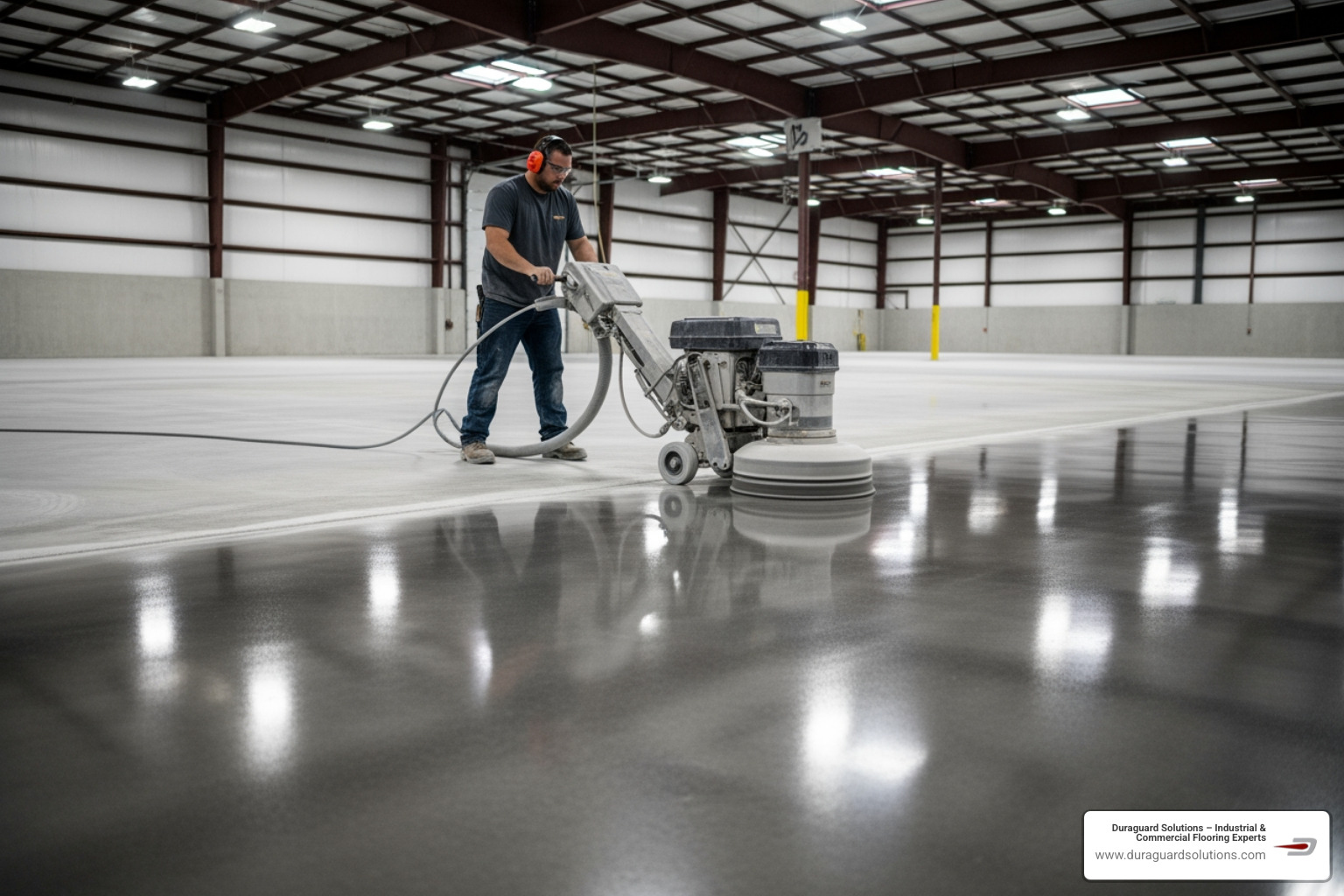
Concrete Grinding and Polishing: From Dusty Slab to Mirror Finish
What Is Concrete Grinding and Polishing — and Is It Right for Your Floor?
Concrete grinding and polishing is a multi-step mechanical process that transforms a raw or damaged concrete slab into a smooth, dense, and highly reflective surface — without adding any topical coatings or waxes.
Here's a quick overview of how it works:
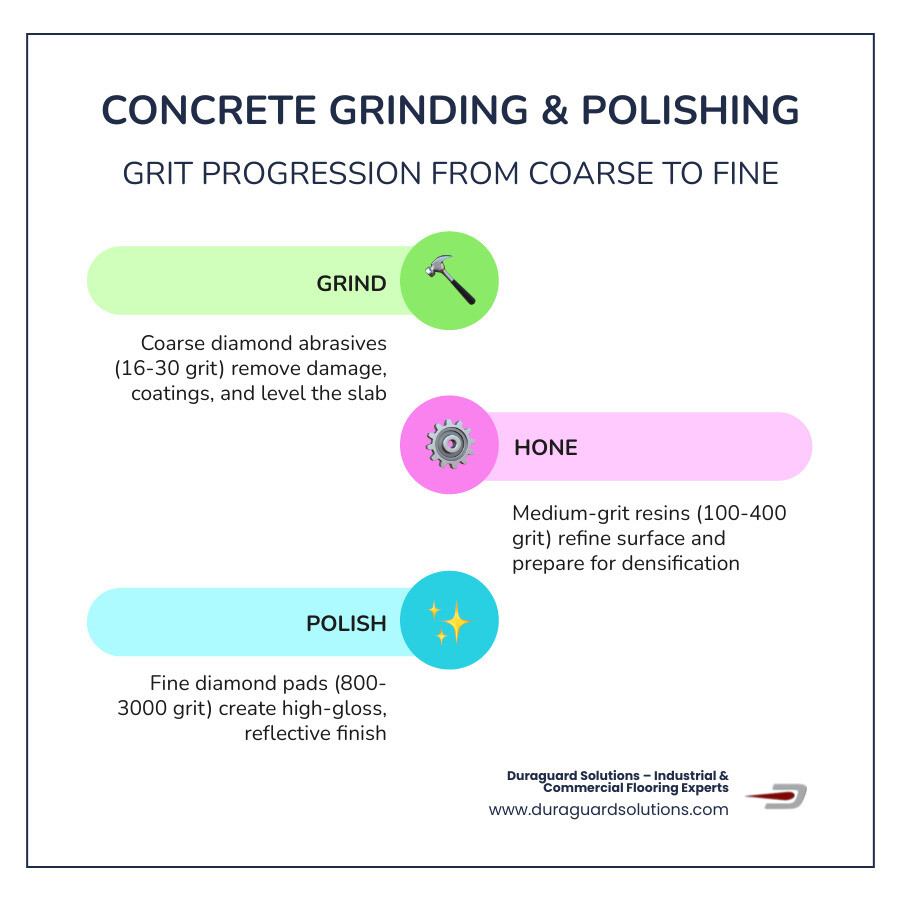
Grind — Coarse diamond abrasives remove surface damage, old coatings, and level the slab
Hone — Medium-grit diamonds refine the surface and close the pores
Densify — A chemical hardener penetrates and hardens the concrete from within
Polish — Fine-grit diamond pads (up to 3000 grit) bring the floor to your desired sheen level
Protect — A breathable stain guard seals the surface without forming a sacrificial wear layer
The result is a floor that can last 20+ years with minimal maintenance — a major advantage for high-traffic industrial and commercial environments.
For facility managers dealing with constant wear, dust contamination, and costly floor repairs, polished concrete isn't just an aesthetic upgrade. It's a long-term operational decision.
But not every floor needs full mechanical polishing. Some situations call for a simpler grind-and-seal approach instead. Knowing the difference — and understanding what your specific slab can actually achieve — is where the process starts.
I'm Mark Barr, owner of Duraguard Solutions and an industrial flooring specialist with extensive hands-on experience in concrete surface preparation and concrete grinding and polishing for warehouses, manufacturing facilities, and food processing plants across Wisconsin and Illinois. In this guide, I'll walk you through the full process, the equipment involved, and how to choose the right finish for your facility's demands.
Understanding the Methods: Polishing vs. Grind-and-Seal
In our industry, the term "polished concrete" is often thrown around loosely. However, there is a massive technical difference between a floor that has been mechanically refined and one that simply has a shiny sealer on top.
Polished concrete is the result of a multi-step mechanical process. We aren't just making the floor look shiny; we are actually changing the molecular structure of the concrete surface. By contrast, a "grind-and-seal" is a more affordable alternative that relies on a topical coating to provide protection and gloss.
Feature Polished Concrete Grind-and-Seal Appearance Natural, varies by slab, mirror-like Consistent, depends on sealer Durability Highest (integral to slab) Moderate (topical layer wears) Maintenance Minimal (dust mop/neutral cleaner) Higher (requires resealing) Cost Higher upfront Lower upfront Lifespan 20+ years to indefinite 3–7 years before reseal Breathability High (allows moisture vapor) Low (traps moisture)
The aesthetic you achieve depends heavily on "aggregate exposure." When we start concrete grinding and polishing, we can choose how deep to cut. A "Cream Finish" barely touches the surface, leaving a marbled look. A "Salt and Pepper" finish reveals the fine sands and small stones, while a "Full Aggregate" exposure involves grinding down about 1/4 to 1/2 inch to show the large stones within the mix.
The Mechanics of Concrete Grinding and Polishing
To achieve that mirror finish, we use heavy-duty planetary grinders equipped with diamond segments. These aren't your average hardware store tools; these machines weigh between 250 and 1,250 pounds to provide the necessary head pressure for the diamonds to "cut" the concrete.
The "magic" happens through internal densification. During the process, we apply a chemical hardener (usually a lithium silicate). This chemical reacts with the calcium hydroxide in the concrete to create calcium silicate hydrate (CSH)—the same stuff that gives concrete its strength. This makes the floor dust-proof and incredibly hard. For facilities that need even more protection, we often discuss polymer flooring systems for areas where mechanical polishing might not be enough.
When to Choose a Grind-and-Seal Finish
While we love a full mechanical polish, it isn't always the right fit. A grind-and-seal is excellent for:
Stain-Prone Areas: If you’re running a commercial kitchen or a garage in Illinois or Wisconsin where road salt and oils are constant, a topical polyurethane or epoxy sealer provides a non-porous barrier.
Damaged Slabs: If the concrete is too soft or has too many air bubbles for a mirror polish, a sealer can bridge those imperfections.
Budget Constraints: It follows many of the steps of the concrete polishing process but stops earlier, saving labor costs.
The downside? You have a "sacrificial wear layer." Eventually, that sealer will scratch or dull, and you'll need to sand it back and re-apply it—something true polished concrete avoids.
The Professional Concrete Grinding and Polishing Process
Achieving a professional result is a slow, methodical game. On average, a 200-square-meter warehouse floor takes about 8 to 12 hours of active grinding spread over two days. If you rush it, you end up with "scratches" that show up like ghosts once the floor gets shiny.
We follow a strict 50% overlap technique with our grinders, moving at a consistent walking pace. We also rotate the direction of the grinder 90 degrees on every pass to ensure the scratch pattern is uniform.
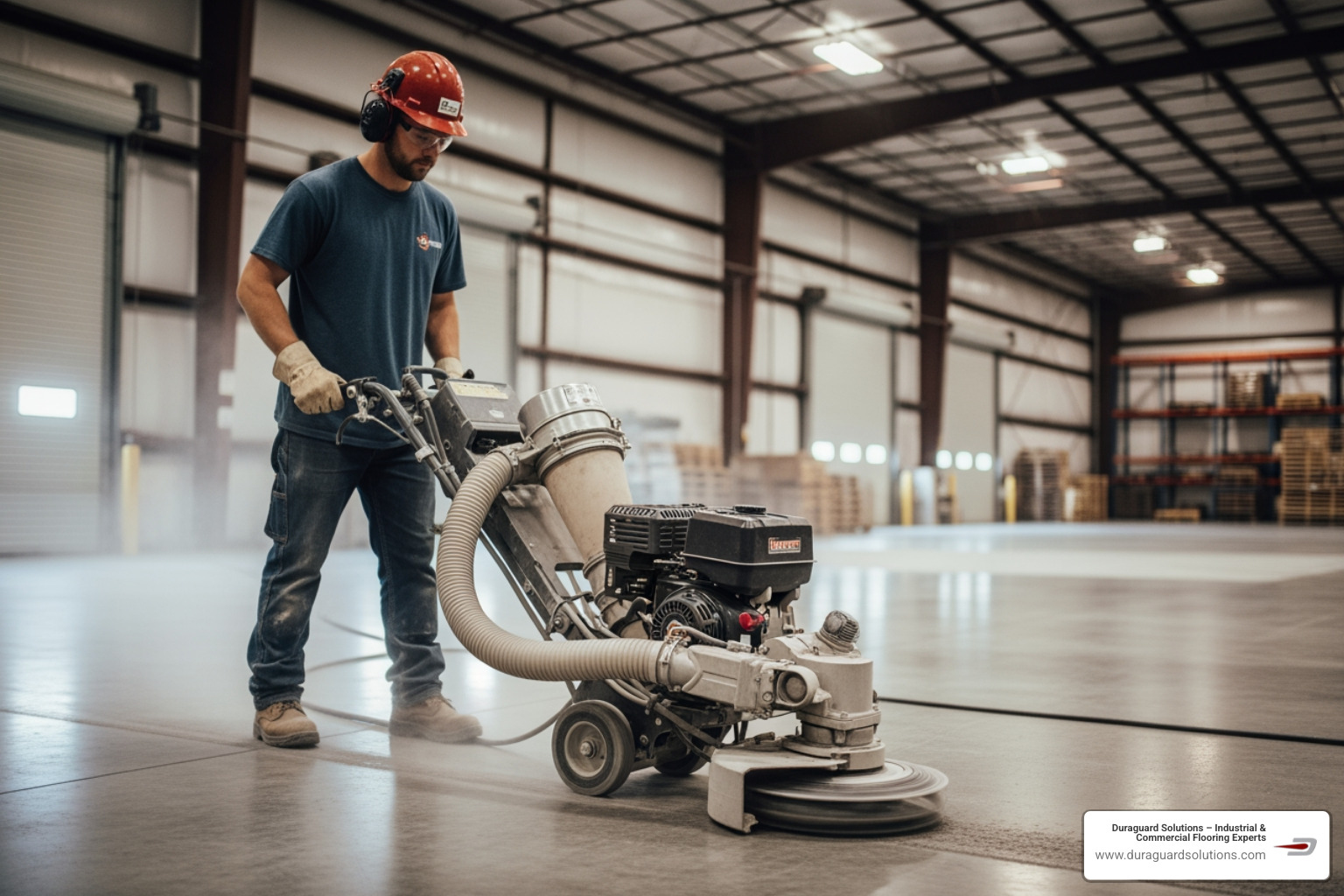
Phase 1: Initial Grinding and Surface Prep
We start with the "heavy lifting." If the floor has old tile glue, epoxy, or carpet mastic, we use 16- to 30-grit metal-bonded diamonds to rip it off. This stage is also where we level high spots to achieve a Floor Flatness (FF) of 50 or higher.
Common challenges during this phase include:
Ghosting: The shadow of old floor tiles that remains even after grinding.
Cracks and Joints: We must repair any cracks wider than 3mm using semi-rigid fillers before we move to the finer grits.
Soft Concrete: If the slab is "rain-damaged" or soft, we have to use specialized diamonds designed for soft bonds.
For those requiring the most rugged surfaces, we often integrate high-performance industrial flooring systems into the prep phase to ensure the base is rock-solid.
Phase 2: Honing and Chemical Densification
Once the surface is flat and the heavy scratches are removed (usually around the 80 to 120 grit mark), we move into the honing phase. This is where we switch from metal-bond diamonds to resin-bond pads (100–400 grit).
This is the critical window for the densifier. We saturate the slab with lithium or potassium silicates. We let it dwell for about 45 minutes to ensure it reacts deep within the pores. This "closes" the concrete, making it much harder and ready to take a shine.
Phase 3: Achieving the Perfect Shine with Concrete Grinding and Polishing
Now for the fun part. We progress through 800 grit (which gives a nice satin sheen) up to 1500 or 3000 grit for a full high-gloss finish.
At this stage, we measure the Distinctness of Image (DOI). A high-quality polish should allow you to see the clear reflection of overhead lights without blurriness. Finally, we apply a "stain guard"—a penetrating sealer that doesn't sit on top like a wax but stays inside the pores. We then use a high-speed burnisher (spinning at 1,500–2,500 rpm) to "heat up" the guard and buff the floor to its final brilliance.
Essential Equipment and Safety Standards
You can't do concrete grinding and polishing with a hand sander and a prayer. Professional results require three-phase power and heavy machinery.
Grinders: We use planetary grinders that feature three or four heads spinning in opposite directions. This eliminates the "swirl marks" common with cheaper, single-head machines.
Power: Most industrial grinders require 220V to 480V power. In remote locations, we use propane-powered grinders, though they offer slightly less torque.
Tooling: A full set of diamond-impregnated pads is essential. You can find more about concrete polishing machines and tooling to see the variety of bonds needed for different concrete hardness levels.
Managing Silica Dust and Workplace Safety
The biggest danger in our industry isn't a heavy machine—it's the dust. Concrete dust contains respirable crystalline silica, which can cause silicosis and lung cancer.
We take this incredibly seriously at Duraguard Solutions. We use M-Class or H-Class dust extractors with HEPA filtration that capture 99.9% of particles down to 0.3 microns. Whether we use the "dry method" (faster and cleaner) or the "wet method" (good for very hard concrete but creates a messy slurry), air quality monitoring and OSHA compliance are non-negotiable. This is especially vital in assembly and warehouse flooring systems where other workers may be present.
Benefits of Polished Concrete for Demanding Environments
Why are so many facilities in Illinois and Wisconsin switching to polished concrete? It’s not just because it looks like a five-star hotel lobby.
Light Reflectivity: A high-gloss floor can increase ambient light by up to 30%. This means you can often turn off half your overhead lights, saving thousands in energy costs.
Lifespan: Unlike epoxy that might peel or tile that can crack, polished concrete is the slab itself. It can last 20 years or more.
LEED Certification: Because we are using the existing slab and avoiding hazardous chemicals, it’s a "green" flooring choice.
Hypoallergenic: There is nowhere for dust, mold, or allergens to hide. It’s a completely seamless, non-porous surface.
Tire Mark Resistance: In warehouses, forklift tires often leave black streaks on epoxy. Polished concrete is much more resistant to these marks.
These benefits are exactly why we recommend it for automotive showroom flooring, where the cars need to look their best and the floor needs to survive heavy foot traffic and occasional oil drips.
Frequently Asked Questions about Concrete Polishing
Is polished concrete slippery when wet?
This is the number one question we get. Surprisingly, polished concrete generally meets or exceeds OSHA standards for slip resistance. While it looks like ice, the mechanical grinding actually creates a high "dynamic coefficient of friction." However, if your floor is constantly wet, we can add specialized anti-slip conditioners to the final guard.
Can any existing concrete slab be polished?
Almost any slab can be ground, but not every slab can be polished to a mirror finish. The concrete needs a minimum strength of 3500 psi. If the slab was poured poorly, has too many air bubbles, or the aggregate was never vibrated correctly, you might end up with a "rustic" look rather than a mirror. In those cases, we might suggest a 50mm topping slab or an epoxy system.
How do you maintain a mirror-like finish?
Stop the wax! The biggest mistake people make is using wax or aggressive acidic cleaners. All you need is a microfiber dust mop for daily cleaning and a neutral pH cleaner for weekly mopping. Every few years, a quick high-speed re-burnish will bring the "pop" back to the shine.
Conclusion
Concrete grinding and polishing is more than just a renovation; it’s an investment in the longevity and efficiency of your facility. From the initial 16-grit grind to the final 3000-grit buff, every step requires precision, the right equipment, and a deep understanding of concrete chemistry.
At Duraguard Solutions – Industrial & Commercial Flooring Experts, we take pride in helping business owners across Illinois and Wisconsin navigate these choices. Whether you need a high-gloss showroom floor or a durable, dust-proof warehouse slab, we have the planetary grinders and the expertise to get it done right.
Ready to see what's hiding under that dusty old slab? Contact Duraguard Solutions for a consultation and let’s talk about transforming your floors today.
