
The Magic of Polyaspartic Concrete Coating Explained
What is Polyaspartic Concrete Coating?
Polyaspartic concrete coating is a high-performance, fast-curing floor coating that outperforms traditional epoxy in nearly every category — from durability and UV resistance to cure speed and temperature flexibility.
Here's a quick summary of what makes it stand out:
Feature Polyaspartic Epoxy Cure time (foot traffic) 3-4 hours 24-72 hours UV stability Yes (no yellowing) No (yellows over time) Temperature range -40°F to 140°F 50-85°F Lifespan 10-20+ years 5-10 years Solids content 85-100%+ Varies (often lower) VOC level Low to near-zero Higher Hot tire resistance Yes Limited
It's a two-component system — a resin and a hardener that cross-link chemically to form an extremely hard, seamless surface. It bonds directly to concrete, handles heavy traffic, resists chemicals, and can be applied year-round, even in cold Wisconsin winters.
For facility managers dealing with harsh industrial environments, that combination is hard to beat.
I'm Mark Barr, Owner of Duraguard Solutions and an industrial flooring specialist with extensive hands-on experience designing and installing polyaspartic concrete coating systems for warehouses, food processing plants, and manufacturing facilities across Wisconsin and Illinois. In this guide, I'll walk you through everything you need to know — from the chemistry and benefits to the full installation process and real-world costs.
To understand the "magic" of this material, we first have to look at its DNA. Technically speaking, a polyaspartic concrete coating is a type of aliphatic polyurea. While it sounds like a mouthful, it essentially means it is a modified version of the high-strength polymers used in spray-on truck bed liners and bridge coatings.
The technology was originally introduced in the early 1990s by Bayer Material Science (now known as Covestro) as a protective coating for steel. However, researchers quickly realized that its unique properties made it the ultimate polymer flooring system for concrete.
Unlike standard polyurea, which cures in a matter of seconds and requires expensive, complex spray equipment, polyaspartic esters allow for a "controlled" reaction. This gives professional installers a workable "pot life" of about 10 to 45 minutes, allowing us to apply the material by hand with rollers and squeegees for a perfectly smooth, glass-like finish.
The Science Behind Polyaspartic Concrete Coating
The secret to its strength lies in the cross-linking. When we mix the two components (the aliphatic polyisocyanate and the polyaspartic ester), a chemical reaction occurs that creates a dense, impenetrable molecular bond.
One of the most impressive aspects of this chemistry is how it handles the environment. According to EPA research on VOCs and indoor air quality, traditional solvent-based coatings can release harmful vapors for days. High-quality polyaspartics, however, often feature 85% to 100% solids content. This means that as the coating cures, almost none of it evaporates into the air. What we roll onto the floor stays on the floor, resulting in a thicker dry film and a much safer environment for our clients in Illinois and Wisconsin.
Versatile Applications for Polyaspartic Concrete Coating
Because this material is so tough, we use it in some of the most demanding environments imaginable. It isn't just for the local garage; it’s a staple in:
Industrial Warehouses: Where heavy forklifts and pallet jacks would tear epoxy to shreds.
Commercial Kitchens: Where hot grease, spilled acids, and constant moisture are daily occurrences.
Aviation: It is the gold standard for aircraft hangar flooring because it resists corrosive hydraulic fluids like Skydrol.
Retail Showrooms: Where the high-gloss finish and custom colors make products pop under the lights.
Outdoor Patios: Because it doesn’t yellow or peel when exposed to the intense summer sun.
Key Benefits: Why Polyaspartic Outperforms Traditional Epoxy
If you’ve ever seen an old epoxy floor, you’ve probably noticed two things: it’s likely yellowed near the windows, and it’s probably peeling where the car tires sit. Polyaspartic concrete coating was designed specifically to solve these "epoxy headaches."
UV Stability and Chemical Resistance
Epoxy is "aromatic," which is a fancy science term meaning it's sensitive to light. When sun hits it, the chemical bonds break down, causing it to turn a sickly amber color. Polyaspartic is "aliphatic," making it 100% UV stable. Whether it’s in a sun-drenched showroom or an outdoor pool deck, the color stays vibrant for decades.
It also offers superior chemical resistance. From road salt in Chicago winters to oil spills in a Green Bay manufacturing plant, these coatings create a non-porous barrier that prevents liquids from ever reaching the concrete substrate.
Temperature Flexibility and Rapid Curing
This is where we see the biggest advantage for our Midwestern clients. Standard epoxy requires a temperature "sweet spot" (usually 55°F to 85°F) to cure correctly. If it's too cold, it stays tacky; if it's too hot, it bubbles.
Polyaspartic is a beast. It can be applied in temperatures ranging from -40°F to 140°F. We can literally install a high-performance floor in the middle of a Wisconsin winter in an unheated warehouse. Furthermore, while epoxy can take days to dry, polyaspartic is walkable in just a few hours. This makes it the premier choice for high-performance industrial flooring where downtime equals lost revenue.
Durability and Performance of Polyaspartic Concrete Coating
When we put these coatings through "Taber abrasion testing"—a process where a weighted abrasive wheel spins on the surface—polyaspartic consistently outperforms epoxy and polyurethane. High-quality systems often show less than 10 mg of loss, meaning they are incredibly difficult to scratch or wear down.
This durability also translates to delamination resistance. Because the material has a lower viscosity when first applied, it actually "wets out" the concrete, penetrating deep into the pores to create a mechanical bond that is stronger than the concrete itself. This prevents the "hot tire pickup" effect where warm tires pull the coating off the floor.
The Professional Application Process
You might have seen "one-day floor" kits at big-box retailers, but true industrial-grade application is a meticulous science. At Duraguard Solutions, we know that a coating is only as good as the preparation beneath it. In fact, 90% of all coating failures are caused by poor surface prep.
Surface Prep and Environmental Readiness
Before a drop of resin touches the floor, we must ensure the concrete is ready. We use industrial diamond grinders to remove the "laitance" (the weak top layer of concrete) and create a specific "profile" or texture. This is similar to sanding wood before painting; it gives the coating something to grab onto.
We also perform moisture testing. If there is too much water vapor rising through the slab, it can cause any coating to bubble. We check for moisture levels and hardness (using a MOHS scale) to ensure the system we choose is perfectly matched to your specific slab. This level of detail is why we are trusted for floor demo and prep services across the region.
Step-by-Step Installation Guide
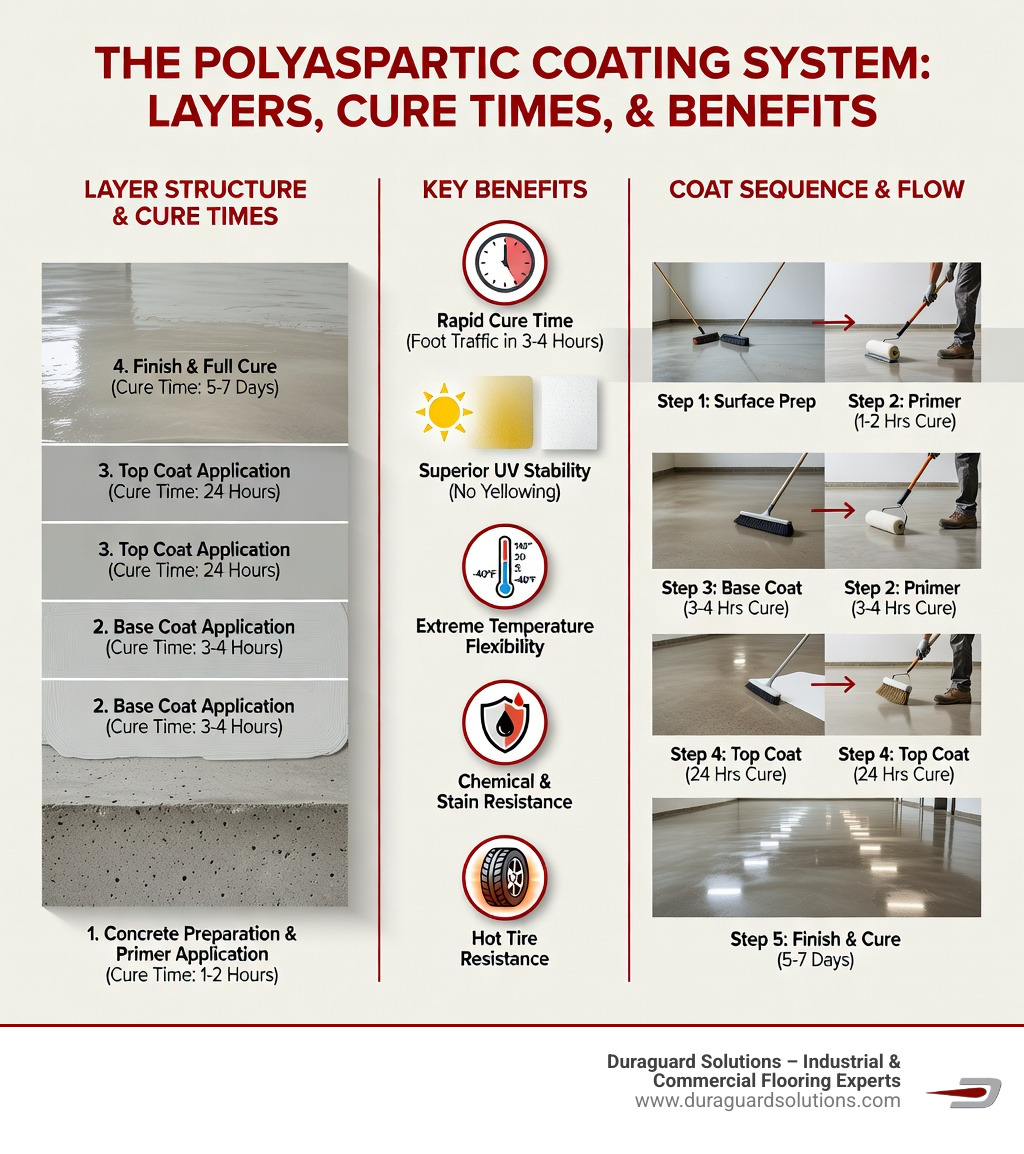
Preparation: Diamond grinding the entire surface and vacuuming with HEPA-filtered industrial vacuums to ensure a dust-free environment.
Repair: Filling cracks and pits with a fast-curing polyurea mender that we grind flush with the floor.
Base Coat: Applying the pigmented polyaspartic concrete coating. Because of the fast cure times, our team works with precision to maintain a "wet edge."
Broadcast: While the base coat is wet, we broadcast decorative flakes or quartz aggregate. This provides color, thickness, and essential slip resistance.
Recovery: Once the base coat is tack-free (usually 30-60 minutes), we scrape off the excess flakes and vacuum the floor again.
Topcoat: Applying the final clear polyaspartic topcoat. This seals the flakes and provides the final layer of protection. We often include a slip-resistant additive to ensure the floor meets coefficient of friction safety standards.
Cost, Maintenance, and Customization
One of the most frequent questions we get is: "Is it worth the extra cost?" While polyaspartic materials can be 20% to 30% more expensive per gallon than basic epoxy, the total ROI is usually much higher. You save significantly on labor because the job is finished faster, and you won't have to pay to replace the floor in five years.
Maintenance and Care
Caring for a polyaspartic floor is incredibly easy because the surface is non-porous. Dirt and grime sit on top rather than soaking in. For daily cleaning, a simple dust mop or soft-bristle broom works wonders. For a deeper clean, we recommend using a pH-neutral cleaner mixed with water.
It is important to spot-clean spills like oil or chemicals as soon as possible. While the floor is resistant, leaving harsh chemicals to sit for weeks is never a good idea. Avoid using acidic cleaners (like vinegar or citrus) or soap-based detergents, as these can leave a dull film on your beautiful high-gloss finish.
Customization Options
We believe a floor should be as unique as the business it supports. Our decorative flooring systems offer endless possibilities:
Full Flake: Available in hundreds of color combinations to hide dirt and provide texture.
Metallic: Uses pearlescent pigments to create a marbled, 3D effect that looks like flowing lava or hammered metal.
Solid Color: For a clean, professional "monolithic" look in labs or warehouses.
Quartz: For extreme-duty industrial environments where extra traction and impact resistance are required.
Frequently Asked Questions about Polyaspartic Coatings
Is polyaspartic coating suitable for DIY application?
In short: no. We strongly advise against DIY for this specific material. Because polyaspartic has an incredibly fast "pot life," you have a very small window to get it on the floor before it hardens in the bucket. Without industrial diamond grinders, professional mixing equipment, and a trained crew, it is very easy to end up with a "meteor shower" of bubbles and lap marks. As noted in the Consumer’s Guide to Residential Garage Concrete Coatings, professional installation is the only way to ensure the long-term warranty and performance of the system.
How long does it take for the floor to cure for vehicle traffic?
This is the "magic" of the system! While an epoxy floor might keep your cars out of the garage for a week, polyaspartic is much faster. Usually, you can walk on the floor in 3 to 4 hours. You can move light furniture back in 12 to 24 hours, and you can drive your vehicles back onto the surface in just 24 to 48 hours.
Can polyaspartic be used on outdoor concrete surfaces?
Absolutely. In fact, it is one of the few resinous coatings we recommend for outdoor use. Because it is 100% UV stable and can handle extreme temperature swings without cracking, it is perfect for pool decks, walkways, and patios. Unlike epoxy, which will flake and yellow in the sun, polyaspartic remains bonded and clear for its entire lifespan.
Conclusion
At Duraguard Solutions, we’ve seen how a high-quality polyaspartic concrete coating can transform a workspace. Whether you are running a heavy manufacturing plant in Illinois or looking to upgrade a commercial showroom in Wisconsin, this technology provides a level of protection that simply wasn't possible twenty years ago.
You get a floor that is hygienic, seamless, incredibly easy to clean, and tough enough to handle whatever you throw at it. If you're ready to move away from temporary fixes and invest in a floor that lasts for decades, we're here to help.
Ready to transform your facility? Contact Duraguard Solutions today for a free consultation and estimate. Let us show you why we are the preferred choice for industrial and commercial flooring in the Midwest.
